BPC-157 + TB-500 Stack Guide
The Wolverine Stack — the most popular peptide combination for injury recovery. Complete dosing protocols, timing, reconstitution, and safety for BPC-157 and TB-500 together.

In This Guide
Stack Overview
The BPC-157 + TB-500 combination — commonly called the “Wolverine Stack” — is the most widely used peptide stack for injury recovery, tissue repair, and healing acceleration. It pairs BPC-157's localized tissue repair and angiogenesis with TB-500's systemic anti-inflammatory and cell migration properties to address injuries from both local and systemic perspectives.
Key Characteristics:
- 2-peptide stack — BPC-157 (Body Protection Compound-157) + TB-500 (Thymosin Beta-4 fragment)
- Primary goal — accelerated injury recovery, tissue repair, and healing for tendons, ligaments, muscles, and joints
- Complementary mechanisms — BPC-157 promotes local angiogenesis and growth factor expression; TB-500 drives systemic anti-inflammation and cell migration
- Experience level — suitable for beginners with peptide experience; one of the most well-documented stacks in the community
- Typical cycle — 6–8 weeks with TB-500 loading phase in the first 4–6 weeks
- Administration — subcutaneous injection for both peptides; BPC-157 can also be taken orally for gut-related conditions
Use our Peptide Dosage to calculate exact doses for both peptides based on your vial sizes and reconstitution volumes.
Why This Stack Works
The Wolverine Stack is effective because BPC-157 and TB-500 operate through fundamentally different but complementary mechanisms. Rather than doubling down on a single pathway, this combination attacks the healing process from two distinct angles.
BPC-157: The Local Repair Agent
- Angiogenesis: upregulates VEGF (vascular endothelial growth factor), promoting formation of new blood vessels at the injury site to deliver nutrients and oxygen
- Growth factor expression: increases EGF, FGF, and other factors that stimulate cell proliferation and tissue remodeling
- Nitric oxide modulation: interacts with the NO system to regulate blood flow, inflammation, and repair signaling at the injury site
- Tendon and collagen: enhances tendon-to-bone healing and collagen organization in animal models
TB-500: The Systemic Healer
- Actin regulation: sequesters G-actin to promote cell migration, allowing repair cells to reach damaged tissue faster
- Anti-inflammatory: reduces systemic inflammation, creating a more favorable environment for healing throughout the body
- Flexibility and remodeling: promotes tissue remodeling and reduces scar tissue formation, improving functional recovery
- Blood cell production: stimulates new blood cell formation and improves endothelial cell function
The Synergy
BPC-157 creates a favorable local healing environment at the injury site — new blood vessels, growth factors, and enhanced nitric oxide signaling. TB-500 complements this by reducing systemic inflammation and promoting the migration of repair cells toward that enriched environment. The result is faster, more complete tissue repair than either peptide alone.
Verified sources for BPC-157 + TB-500
These vendors are vetted by PeptideWiki for purity testing and COA transparency.
Individual Peptide Breakdown
Each peptide in this stack has a dedicated dosage guide with complete individual protocols. Here is a summary of each peptide's role in this stack.
BPC-157 (Body Protection Compound-157)
- Type: Synthetic pentadecapeptide (15 amino acids)
- Origin: Derived from human gastric juice proteins
- Role in stack: Localized tissue repair, angiogenesis, growth factor upregulation
- Route: Subcutaneous injection (near injury) or oral
- Frequency: Once or twice daily
TB-500 (Thymosin Beta-4 Fragment)
- Type: Synthetic peptide fragment of Thymosin Beta-4 (43 amino acids)
- Origin: Based on naturally occurring thymic peptide involved in cell migration
- Role in stack: Systemic anti-inflammation, cell migration, tissue remodeling
- Route: Subcutaneous injection
- Frequency: Twice weekly (loading), once weekly (maintenance)
Dosing Protocol
The Wolverine Stack uses different dosing frequencies for each peptide. BPC-157 is injected daily while TB-500 follows a loading/maintenance schedule with less frequent injections.
Standard Protocol
| Compound | Dose | Frequency | Route | Notes |
|---|---|---|---|---|
| BPC-157 | 250 mcg | Twice daily | SubQ (near injury) | Consistent daily dosing throughout the entire cycle |
| TB-500 | 2–2.5 mg | Twice weekly (loading) | SubQ (abdomen or near injury) | Loading phase: weeks 1–4 to build systemic levels |
| TB-500 | 2–2.5 mg | Once weekly (maintenance) | SubQ (abdomen or near injury) | Maintenance phase: weeks 5–8 after loading |
Conservative Protocol (Lower Dose)
Calculate Your Doses
Both peptides are supplied as lyophilized powder and need reconstitution with bacteriostatic water. The dose you draw depends on the concentration after reconstitution.
BPC-157 — 5 mg Vial
- Vial size: 5 mg (5,000 mcg)
- Bacteriostatic water: 2 mL
- Concentration: 5,000 ÷ 2 = 2,500 mcg/mL
- 250 mcg dose = 0.1 mL = 10 units on insulin syringe
- Doses per vial: 20 doses
TB-500 — 5 mg Vial
- Vial size: 5 mg (5,000 mcg)
- Bacteriostatic water: 1 mL
- Concentration: 5,000 ÷ 1 = 5,000 mcg/mL
- 2.5 mg dose = 0.5 mL = 50 units on insulin syringe
- Doses per vial: 2 doses
Skip the Math — Use Our
Enter your vial size, water volume, and desired dose for each peptide — get instant calculations with zero manual math.
Reconstitution Guide
Both peptides follow the same reconstitution process. Reconstitute each vial separately with bacteriostatic water.
| Peptide | Vial Size | Bac Water | Concentration | Standard Dose Draw |
|---|---|---|---|---|
| BPC-157 | 5 mg | 2 mL | 2,500 mcg/mL | 10 units (0.1 mL) for 250 mcg |
| TB-500 | 5 mg | 1 mL | 5,000 mcg/mL | 50 units (0.5 mL) for 2.5 mg |
Wash Hands & Prepare Workspace
Wash hands thoroughly. Lay out supplies: peptide vials, bacteriostatic water, insulin syringes, and alcohol swabs on a clean surface.
Swab Both Vial Stoppers
Remove plastic caps and swab the rubber stoppers of the peptide vial and bacteriostatic water vial with alcohol pads. Let air-dry for 10–15 seconds.
Add Water to Peptide Vial
Draw the appropriate volume of bacteriostatic water. Insert needle into peptide vial and direct the stream down the inside glass wall — never squirt directly onto the powder. Release slowly.
Dissolve Gently
Let the vial sit for 1–2 minutes, then gently swirl or roll between palms until fully dissolved. Solution should be clear and colorless. Never shake.
Label & Refrigerate
Write the reconstitution date and concentration on each vial. Store refrigerated at 2–8°C. Use within 28–30 days.
For a detailed visual walkthrough, see our Reconstitution Guide.
Timing & Daily Schedule
BPC-157 and TB-500 have different dosing frequencies. Here is how a typical week looks during the loading phase (weeks 1–4):
| Day | BPC-157 | TB-500 |
|---|---|---|
| Monday | 250 mcg AM + 250 mcg PM | 2.5 mg |
| Tuesday | 250 mcg AM + 250 mcg PM | — |
| Wednesday | 250 mcg AM + 250 mcg PM | — |
| Thursday | 250 mcg AM + 250 mcg PM | 2.5 mg |
| Friday | 250 mcg AM + 250 mcg PM | — |
| Saturday | 250 mcg AM + 250 mcg PM | — |
| Sunday | 250 mcg AM + 250 mcg PM | — |
Timing Notes
- BPC-157: Split doses 8–12 hours apart (e.g., 8 AM and 8 PM). No strict meal or fasting requirements for injectable dosing.
- TB-500: Can be injected at any time of day. Space injections 3–4 days apart during loading (e.g., Monday/Thursday or Tuesday/Friday).
- Same session: Both peptides can be injected in the same session using separate syringes. No waiting period between the two injections.
- Injection site: BPC-157 near the injury for localized effect; TB-500 works systemically from any SubQ site (abdomen is most convenient).
Cycling & Duration
The Wolverine Stack is typically run for 6–8 weeks. Longer cycles are possible for chronic injuries but should include periodic reassessment.
| Phase | Duration | BPC-157 | TB-500 |
|---|---|---|---|
| Loading | Weeks 1–4 | 250 mcg 2x/day | 2–2.5 mg 2x/week |
| Maintenance | Weeks 5–8 | 250 mcg 2x/day | 2–2.5 mg 1x/week |
| Break | 2–4 weeks off | None | None |
| Repeat (if needed) | 6–8 weeks | Resume full protocol | Resume with loading phase |
When to Extend the Cycle
- Chronic tendinopathy: Old injuries with established scar tissue may need 10–12 weeks for meaningful remodeling
- Post-surgical recovery: Complex surgical repairs (ACL, rotator cuff) may benefit from extended 8–12 week protocols
- Multiple injury sites: When healing several areas simultaneously, a longer cycle allows adequate repair time for each
Why Take a Break?
Neither BPC-157 nor TB-500 has demonstrated tolerance buildup in available research. The break period serves to: (1) assess healing progress without peptide support, (2) confirm that improvement is structural rather than just symptomatic, and (3) reduce unnecessary exposure to research compounds when the therapeutic goal may have been achieved.
Safety, Side Effects & Contraindications
Common Side Effects
- Injection site redness, soreness, or minor swelling — the most common report
- Mild nausea — more common with BPC-157, usually resolves within days
- Transient fatigue or lethargy — occasionally reported
- Headache — may occur in the first few days of use
- Dizziness or lightheadedness — rare, typically mild and short-lived
Contraindications
- Active cancer or history of cancer: Both peptides promote angiogenesis (BPC-157) and cell migration (TB-500), which could theoretically support tumor growth. Avoid use with active malignancies.
- Pregnancy and breastfeeding: No safety data exists for either peptide during pregnancy or nursing. Avoid entirely.
- Active infections at injection site: Do not inject through infected, inflamed, or broken skin.
- Anticoagulant therapy: BPC-157 interacts with the NO system and may affect platelet function. Consult your healthcare provider if taking blood thinners.
Stack-Specific Safety Notes
- No known negative interaction: BPC-157 and TB-500 have not been shown to interfere with each other. They operate through different mechanisms and pathways.
- Increased angiogenic load: Both peptides promote aspects of tissue repair that involve vascularization. While this is beneficial for healing, it reinforces the theoretical concern about use with active cancers.
- Separate syringes: Use dedicated syringes for each peptide to avoid any potential compatibility issues in solution.
Common Wolverine Stack Mistakes
Avoid these common errors to get the most out of your BPC-157 + TB-500 protocol:
Frequently Asked Questions
Key Takeaways
- The Wolverine Stack (BPC-157 + TB-500) is the most popular healing peptide combination — addressing injury from both local (BPC-157) and systemic (TB-500) angles
- BPC-157 dose: 250 mcg SubQ twice daily near the injury site throughout the entire 6–8 week cycle
- TB-500 dose: 2–2.5 mg SubQ twice weekly (loading) then once weekly (maintenance)
- TB-500 requires a loading phase (weeks 1–4) to build systemic levels before dropping to maintenance
- Use separate syringes for each peptide — do not mix in the same syringe
- Typical cycle: 6–8 weeks with 2–4 weeks off before repeating if needed
- Refrigerate reconstituted vials at 2–8°C and use within 28–30 days
- Not a replacement for rest and rehabilitation — use as part of a comprehensive recovery plan
- Neither peptide is FDA-approved for human use. Both are classified as research peptides and banned by WADA.
This article is for educational and informational purposes only. See our Disclaimer.
References
- Sikiric P, et al. “Stable gastric pentadecapeptide BPC 157: novel therapy in gastrointestinal tract.” Curr Pharm Des. 2018;24(18):1990-2001.
- Staresinic M, et al. “Gastric pentadecapeptide BPC 157 accelerates healing of transected rat Achilles tendon.” J Orthop Res. 2003;21(6):976-983.
- Goldstein AL, et al. “Thymosin beta4: actin-sequestering protein moonlights to repair injured tissues.” Trends Mol Med. 2005;11(9):421-429.
- Malinda KM, et al. “Thymosin beta4 accelerates wound healing.” J Invest Dermatol. 1999;113(3):364-368.
- Sosne G, et al. “Thymosin beta 4 promotes corneal wound healing and decreases inflammation in vivo following alkali injury.” Exp Eye Res. 2002;74(2):293-299.
- Seiwerth S, et al. “BPC 157's effect on healing.” J Physiol Paris. 2014;108(2-3):51-59.
- Sikiric P, et al. “Brain-gut axis and pentadecapeptide BPC 157: theoretical and practical implications.” Curr Neuropharmacol. 2016;14(8):857-865.
Next Steps
Continue your research with these resources.
BPC-157 Dosage Guide
Complete individual dosing protocols, reconstitution, and injection guide for BPC-157.
Read GuideTB-500 Dosage Guide
Complete individual dosing protocols, loading/maintenance phases, and safety for TB-500.
Read GuideWolverine Stack Deep Dive
Full breakdown of the BPC-157 + TB-500 combination with dosing, benefits, and real-world protocols.
Read Article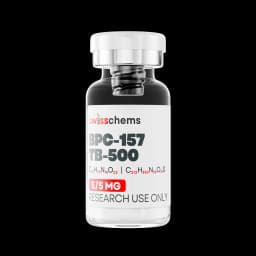
Ready to source BPC-157 + TB-500?
Use code PEPTIDEWIKI for 10% off every order at SwissChems.
Affiliate link — commission at no extra cost to you.