Peptide Protocol Tracker
Build, organize, and download your complete peptide protocol — with built-in dose calculations, weekly scheduling, and a printable PDF.
This free tool lets you plan your peptide protocol in one place. Search our database to add peptides, configure your dose and reconstitution details, then schedule which days you take each one. The tracker auto-calculates your syringe units so you never have to do the math yourself — just enter your vial size in mg and ml of bacteriostatic water. When you're done, download everything as a clean PDF you can print or share with your provider.
Quick Start
Detailed directions, reconstitution help, and FAQ are located below the tracker.
What Is a Peptide Protocol?
A peptide protocol is a structured plan that defines which peptides you take, at what dose, how often, and for how long. Rather than guessing or trying to remember your routine, a written protocol ensures consistency — which is critical for meaningful results in any research setting.
Protocols typically specify the dose in micrograms (mcg) or milligrams (mg), the administration route (subcutaneous injection, intramuscular, oral, or nasal), the timing of each dose (morning, evening, or bedtime), and the frequency (daily, every other day, or a set number of times per week). Not sure where to start? Our beginner's guide to peptides covers the fundamentals.
The tracker above lets you build a complete protocol from our peptide database. Doses are auto-populated from published research ranges, and the built-in reconstitution calculator converts your dose into exact syringe units — eliminating the most error-prone step in peptide preparation. Browse our full peptide directory to explore available compounds and their research profiles.
Example Protocol
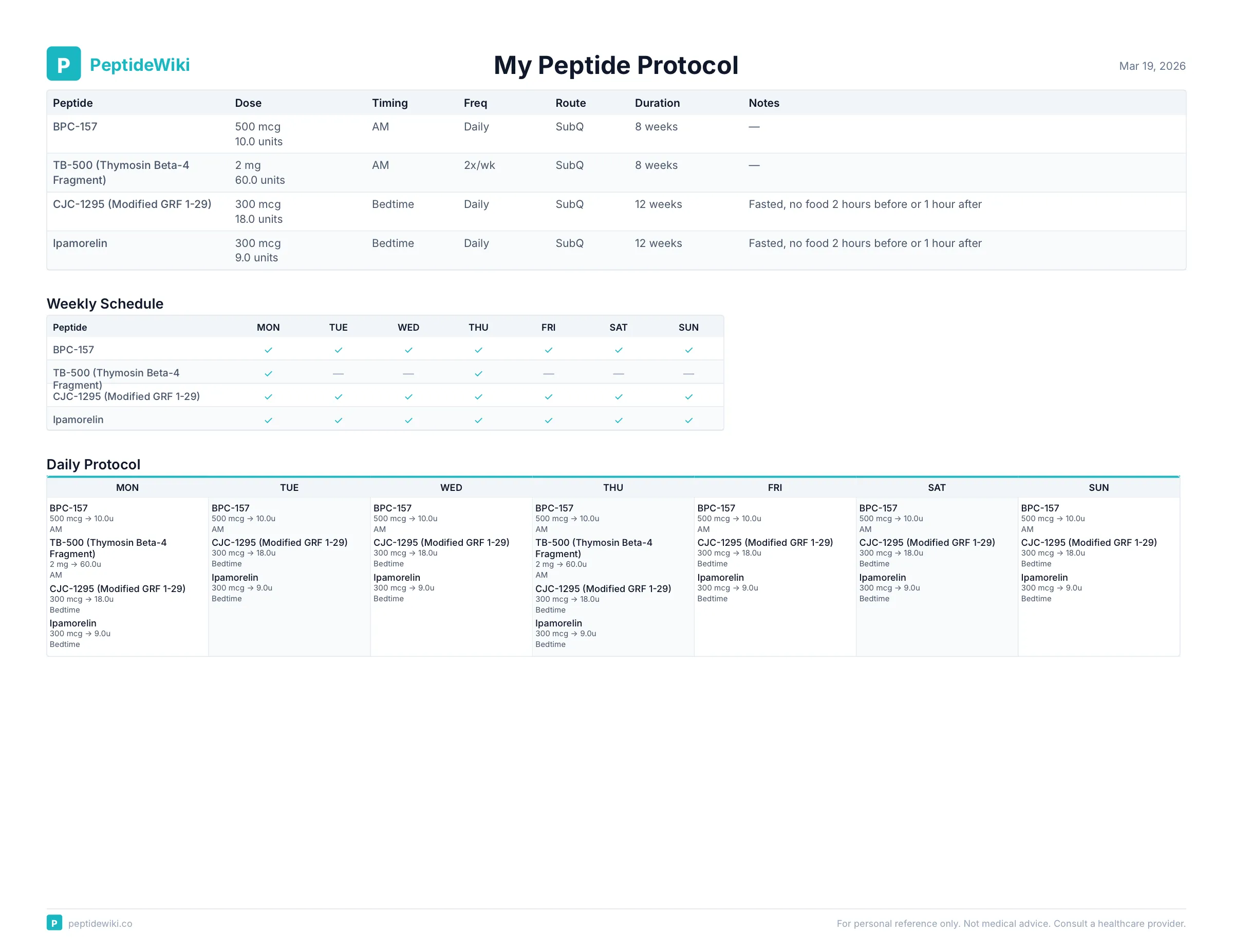
Here's what a completed protocol looks like when downloaded as a PDF.
How to Build Your First Protocol
Choose Your Peptides
Browse our peptide directory or guides to find the right peptides, then add them to your protocol. Each peptide auto-populates with recommended dose ranges, administration routes, and typical cycle durations pulled from published research.
Set Your Dose
The tracker fills in a recommended dose range (e.g. 200–500 mcg). Choose a specific number within that range — most beginners start at the low end. Check our dosage guides for evidence-based protocols. Once you enter a single dose, the syringe units calculator activates.
Configure Reconstitution
Enter your vial size in mg and the amount of bacteriostatic water you added in ml. The tracker instantly calculates how many units to draw on an insulin syringe for your exact dose — no manual math required. New to reconstitution? Read our step-by-step reconstitution guide.
Schedule Your Days
Use the weekly calendar to toggle which days you take each peptide. This is especially useful for peptides dosed 3x or 5x per week. The daily protocol view shows exactly what to take each day at a glance.
Download Your PDF
Click the download button to generate a branded PDF protocol sheet. The PDF includes every peptide, dose, syringe units, route, timing, frequency, duration, notes, and your full weekly schedule.
Understanding Reconstitution & Syringe Units
Most research peptides ship as lyophilized (freeze-dried) powder. Before they can be measured and administered, you need to reconstitute them by adding bacteriostatic water to the vial. The amount of water you add determines the concentration of the solution, which in turn determines how many units to draw on an insulin syringe.
The protocol tracker handles this math automatically. For each peptide in your protocol, enter the vial size (mg) and the amount of water you added (ml). The tracker instantly shows the syringe units for your dose — displayed as a small badge next to the reconstitution fields.
Frequently Asked Questions
How do I choose a dose when the tracker shows a range?
The tracker auto-populates recommended dose ranges from our database (e.g. 200–500 mcg for BPC-157). Pick a specific number within that range — most beginners start at the low end. Once you enter a single number, the tracker calculates your exact syringe units automatically.
How does the built-in reconstitution calculator work?
Enter your vial size (mg) and the amount of bacteriostatic water you added (ml). The tracker uses the formula: units = (dose ÷ concentration) × 100, where concentration = (vial mg × 1000) ÷ water ml. The result tells you exactly how many units to draw on an insulin syringe.
Can I save my protocol and come back later?
The tracker runs entirely in your browser — nothing is stored on our servers. To keep a copy, click the Download PDF button. This generates a branded protocol sheet with all your peptides, doses, syringe units, and weekly schedule that you can save, print, or share with a healthcare provider.
What information is included in the PDF download?
The PDF includes every peptide in your protocol with its dose, reconstitution details, calculated syringe units, administration route, timing, frequency, duration, and notes. It also includes your weekly schedule showing which peptides are taken on which days.
Is this medical advice?
No. The Peptide Protocol Tracker is an educational and organizational tool for research purposes only. It does not provide medical advice, diagnosis, or treatment recommendations. Always consult a qualified healthcare provider before using any peptide.
Next Steps
Dosage Calculator
Calculate your exact peptide dose based on vial size, reconstitution volume, and target dose.
Open CalculatorBeginner's Guide
New to peptides? Learn the fundamentals — what they are, how they work, and how to start safely.
Read GuideTake the Quiz
Not sure which peptide fits your research goals? Get personalized recommendations in 2 minutes.
Start QuizGet the latest peptide research
New dosage guides, research summaries, and community insights delivered weekly.
This tracker is provided for educational and informational purposes. For more information, see our peptide directory or beginner's guide to peptides.