GHK-Cu Dosage Guide
Evidence-based protocols for copper peptide GHK-Cu — injectable and topical dosing, reconstitution, injection technique, stacking with BPC-157, cycling, and safety.

In This Guide
What Is GHK-Cu?
GHK-Cu (copper peptide GHK-Cu, or glycyl-L-histidyl-L-lysine:copper(II)) is a naturally occurring tripeptide with high affinity for copper(II) ions. It was first isolated from human plasma by Dr. Loren Pickart in 1973 and has been studied extensively since — with over 60 published studies spanning four decades across wound healing, collagen synthesis, anti-aging, and tissue remodeling.
What makes GHK-Cu unusual is the dual-route approach. Unlike most peptides in the research community, GHK-Cu has established protocols for both injectable and topical use, each targeting different goals. Injectable dosing provides systemic healing and tissue remodeling, while topical formulations target localized skin rejuvenation and wound repair. This guide covers both routes: injectable dosing for systemic healing, topical formulations for skin rejuvenation, reconstitution, stacking, safety, and how to choose the right route for your goals.
Use our Peptide Dosage to calculate your exact injectable dose based on vial size and concentration.
Key Characteristics:
- Naturally occurring — found in human plasma, saliva, and urine; declines with age (200 ng/mL in youth, dropping to 80 ng/mL by age 60)
- Copper delivery — binds and delivers copper ions, which are essential cofactors for enzymes involved in tissue repair, including superoxide dismutase and lysyl oxidase
- Collagen synthesis — stimulates production of collagen types I and III, decorin, elastin, and glycosaminoglycans
- Wound healing — accelerates wound closure, attracts immune cells, and promotes angiogenesis (new blood vessel formation)
- Anti-inflammatory — reduces inflammatory cytokines including TNF-alpha and IL-6
- Gene modulation — studies show GHK-Cu affects expression of over 4,000 genes, resetting many toward a healthier expression profile associated with younger tissue
- Dual routes — effective both systemically (injectable) and locally (topical) — one of the few peptides with established protocols for both
For a complete overview of its mechanism and research, see our full GHK-Cu profile. New to peptides? Start with the Beginner's Guide to Peptides.
How GHK-Cu Dosage Is Determined
GHK-Cu dosing is informed by decades of published research, primarily in wound healing and dermatology. Unlike many research peptides that rely solely on animal dose translation, GHK-Cu benefits from direct human studies (topical) and well-characterized plasma concentration data that help frame injectable dosing.
Published Research
GHK-Cu has one of the longest research histories of any peptide in this space. Key sources include topical studies using 1–2% GHK-Cu creams and serums in human subjects, injectable studies in animal models and cell cultures demonstrating tissue repair and gene modulation, and plasma concentration studies establishing that natural GHK-Cu levels decline from approximately 200 ng/mL in youth to 80 ng/mL by age 60.
Community & Practitioner Experience
Injectable GHK-Cu dosing at 1–2 mg per day subcutaneously emerged from practitioners and the research peptide community. This range is informed by the goal of restoring youthful plasma GHK-Cu levels while remaining within practical dosing parameters. Topical protocols are more standardized, with 1–2% concentrations supported by published human skin studies.
Injectable GHK-Cu Dosage Ranges
Injectable GHK-Cu is administered subcutaneously once daily. Dosing is straightforward compared to many peptides — most protocols use a fixed daily dose rather than weight-based calculations.
| Level | Dose per Injection | Frequency | Daily Total |
|---|---|---|---|
| Conservative | 0.5 mg | Once daily | 0.5 mg/day |
| Standard | 1.0 mg | Once daily | 1.0 mg/day |
| Aggressive | 2.0 mg | Once daily | 2.0 mg/day |
Verified sources for GHK-Cu
These vendors are vetted by PeptideWiki for purity testing and COA transparency.
Topical GHK-Cu Protocols
Topical GHK-Cu is the best-studied route of administration, with multiple human trials demonstrating improvements in skin thickness, collagen density, firmness, and reduction of fine lines and photodamage. Topical products are widely available as over-the-counter cosmetic formulations.
| Formulation | Concentration | Frequency | Application Area |
|---|---|---|---|
| Serum | 1–2% GHK-Cu | 1–2x daily | Face, neck, target areas |
| Cream | 0.5–1% GHK-Cu | 1–2x daily | Face, body, wound sites |
| Custom (compounded) | 1–3% GHK-Cu | 1–2x daily | Per provider instructions |
Topical Application Tips
- Apply to clean skin — after cleansing, before heavier creams or moisturizers
- Consistency is key — daily application for 4–8 weeks before assessing results
- No cycling needed — topical GHK-Cu can be used continuously as part of a daily skincare routine
- Avoid combining with strong acids — do not layer with L-ascorbic acid (vitamin C) or high-concentration AHAs/BHAs, which can destabilize the copper peptide
- Patch test first — apply to a small area on the inner forearm and wait 24 hours to check for irritation
Calculate Your Injectable GHK-Cu Dose
Injectable GHK-Cu is supplied as a lyophilized (freeze-dried) powder, typically in 5 mg, 10 mg, or 50 mg vials. You reconstitute it with bacteriostatic water, then draw your dose using an insulin syringe. The concentration depends on how much water you add to the vial.
Worked Example:
- Vial size: 5 mg (5,000 mcg) of GHK-Cu
- Bacteriostatic water added: 2 mL
- Concentration: 5,000 mcg ÷ 2 mL = 2,500 mcg per mL
- Target dose: 1.0 mg (1,000 mcg)
- Volume to draw: 1,000 ÷ 2,500 = 0.4 mL = 40 units on an insulin syringe
Quick Reference — Common Vial Sizes
| Vial / Bac Water | Concentration | 1.0 mg Dose | Doses per Vial |
|---|---|---|---|
| 5 mg / 2 mL | 2.5 mg/mL | 40 units (0.4 mL) | 5 doses |
| 10 mg / 2 mL | 5.0 mg/mL | 20 units (0.2 mL) | 10 doses |
| 50 mg / 5 mL | 10 mg/mL | 10 units (0.1 mL) | 50 doses |
Calculate Your GHK-Cu Dose Instantly
Enter your GHK-Cu vial size, water volume, and desired dose — get instant calculations with zero manual math.
How to Reconstitute Injectable GHK-Cu
GHK-Cu comes as a lyophilized (freeze-dried) powder that must be reconstituted with bacteriostatic water before injection. The process is the same as for other peptides, with one notable difference: expect a slight blue or blue-green tint from the copper ion — this is completely normal.
Supplies Needed:
- GHK-Cu lyophilized vial (5 mg, 10 mg, or 50 mg)
- Bacteriostatic water (BAC water) — contains 0.9% benzyl alcohol as preservative
- Insulin syringes (29–31 gauge, 0.5 mL or 1 mL) for injection
- Alcohol swabs (70% isopropyl alcohol)
- Clean, flat workspace
- Optional: larger syringe (1–3 mL) for drawing bacteriostatic water if using a separate drawing needle
Steps
Wash Hands & Prepare Workspace
Wash hands thoroughly with soap and water. Lay out supplies on a clean surface: GHK-Cu vial, bacteriostatic water, insulin syringe, and alcohol swabs.
Remove the Vial Caps
Flip off the plastic caps from both the GHK-Cu vial and the bacteriostatic water vial. Swab both rubber stoppers with alcohol pads and let them air-dry for 10–15 seconds.
Draw Bacteriostatic Water
Using a fresh insulin syringe, draw your desired volume of bacteriostatic water. For a 5 mg vial, 2 mL is standard (yields 2,500 mcg per mL).
Add Water to the Peptide Calculator Vial
Insert the needle into the GHK-Cu vial through the rubber stopper. Angle the needle so the water runs down the inside glass wall — never squirt directly onto the powder cake. Release the plunger slowly.
Dissolve Gently & Observe Color
Remove the syringe. Let the vial sit for 1–2 minutes, then gently swirl or roll between your palms until the powder is fully dissolved. Expect a slight blue or blue-green tint — this is normal for copper peptides. Never shake.
Label & Refrigerate
Write the reconstitution date and concentration on the vial. Store refrigerated at 2–8°C. Use within 3–4 weeks.
Storage
- Unreconstituted (powder): Store refrigerated (2–8°C) for maximum shelf life; room temperature is acceptable for short periods but reduces potency over time
- Reconstituted (in bacteriostatic water): Must be refrigerated at 2–8°C; use within 3–4 weeks
- Do not freeze: Freezing reconstituted GHK-Cu can damage the peptide structure through ice crystal formation
- Protect from light and heat — keep the vial in its box or wrapped in foil, away from direct sunlight and temperatures above 25°C
For a detailed visual walkthrough, see our Reconstitution Guide.
GHK-Cu Dosage by Goal
GHK-Cu's dual-route flexibility means the optimal protocol varies significantly depending on what you're targeting. The table below summarizes common goal-specific approaches, followed by detailed breakdowns.
Skin Rejuvenation & Anti-Aging
The most widely studied use case for GHK-Cu. Topical formulations have demonstrated improvements in skin thickness, collagen density, firmness, elasticity, and reduction of fine lines in human studies. Injectable GHK-Cu adds systemic support for collagen synthesis and tissue remodeling. Many users combine both routes for maximum effect.
- Injectable: 1.0 mg/day SubQ for 4–8 weeks
- Topical: 1–2% serum, 2x daily, ongoing
- Combined approach: Injectable for systemic collagen support + topical for localized skin improvement
Wound Healing & Post-Surgical Recovery
GHK-Cu accelerates wound closure, promotes angiogenesis, attracts immune cells, and stimulates collagen deposition. Injectable dosing is used systemically to support overall healing, while topical application is added to the wound area once initial granulation tissue has formed.
- Injectable: 1–2 mg/day SubQ for 2–4 weeks
- Topical: Apply to wound area once granulation begins
- Note: Often stacked with BPC-157 for complementary healing mechanisms
Hair Growth Support
GHK-Cu has shown potential for supporting hair growth by stimulating hair follicle stem cells, increasing follicle size, and extending the anagen (growth) phase. Both topical scalp application and injectable protocols are used, often together.
- Topical: 1–2% solution applied to scalp daily
- Injectable: 1.0 mg/day SubQ for 8–12 weeks
- Note: Hair growth is slow; allow 8–12 weeks for visible results
Systemic Anti-Inflammatory & Tissue Repair
GHK-Cu reduces inflammatory cytokines (TNF-alpha, IL-6) and modulates gene expression toward healthier patterns. Injectable dosing is used for general anti-inflammatory and tissue repair support, often as part of a broader recovery protocol.
- Injectable: 1–2 mg/day SubQ for 4–8 weeks
- Commonly stacked with: BPC-157 for comprehensive healing
GHK-Cu Injection Guide
Subcutaneous (SubQ) Injection — Step by Step
Wash Hands & Prepare
Wash hands thoroughly with soap and water. Prepare a clean workspace with your syringe, alcohol swab, and reconstituted GHK-Cu vial.
Swab the Vial Stopper
Wipe the rubber stopper of the GHK-Cu vial with an alcohol swab. Let it air-dry for 10–15 seconds.
Draw Your Dose
Pull back the plunger to draw air equal to your dose volume. Insert the needle into the vial, push in the air, invert the vial, and slowly draw out your calculated dose. Tap out any air bubbles. The solution may have a slight blue/green tint — this is normal.
Select Injection Site
The abdomen (2–3 inches from the navel) or front of the thigh are the most common SubQ injection sites for GHK-Cu. Rotate sites daily to avoid irritation.
Clean the Injection Site
Swab the chosen injection site with a fresh alcohol pad. Allow to air-dry completely before injecting.
Inject
Pinch a fold of skin between your thumb and forefinger. Insert the needle at a 45-degree angle into the pinched skin fold. Push the plunger slowly and steadily. Withdraw the needle and apply gentle pressure with the alcohol swab if needed.
Dispose Safely
Place the used syringe immediately into a sharps container. Never recap or reuse needles.
GHK-Cu Cycle Duration & Timing
Injectable GHK-Cu is typically used in defined cycles, while topical GHK-Cu can be used continuously. The cycling recommendations below reflect community best practices and the general principle of periodic breaks for injectable peptides.
| Protocol | Duration | Best For |
|---|---|---|
| Standard injectable cycle | 4–8 weeks on, 4 weeks off | Skin rejuvenation, general healing, anti-inflammatory |
| Extended injectable cycle | 8–12 weeks on, 4 weeks off | Hair growth support, chronic wound healing |
| Topical (ongoing) | Continuous — no cycling needed | Daily skincare, cosmetic maintenance |
Time of Day
- Injectable: Once daily at any consistent time. Morning is most common, but GHK-Cu does not need to be timed around meals, workouts, or sleep.
- Topical (serum): Apply in the morning after cleansing and/or in the evening as part of your skincare routine. Twice daily application provides better results than once daily.
- Topical (wound healing): Apply once or twice daily after gently cleaning the wound area.
GHK-Cu Stacking Protocols
GHK-Cu is frequently combined with other peptides to enhance healing outcomes. Its collagen-stimulating and tissue-remodeling properties complement peptides that target different aspects of tissue repair and immune support.
GHK-Cu + BPC-157 — Comprehensive Healing Stack
The most popular GHK-Cu stack. GHK-Cu promotes collagen synthesis, tissue remodeling, and copper-dependent enzyme activity, while BPC-157 drives angiogenesis, growth factor expression, and localized tissue repair. Together they address wound healing from multiple biological angles.
GHK-Cu + Thymosin Alpha-1 — Immune + Repair Stack
This stack combines GHK-Cu's tissue repair and anti-inflammatory properties with Thymosin Alpha-1's immune-modulating effects. Thymosin Alpha-1 enhances T-cell function and immune surveillance, while GHK-Cu supports collagen remodeling and reduces inflammatory cytokines. This combination is used for post-illness recovery, chronic inflammation, and immune system support alongside tissue repair.
| Compound | Dose | Frequency | Purpose |
|---|---|---|---|
| GHK-Cu | 1 mg SubQ | Once daily | Tissue remodeling, collagen synthesis, anti-inflammatory |
| Thymosin Alpha-1 | 1.6 mg SubQ | 2–3x per week | Immune modulation, T-cell activation, immune surveillance |
Explore more combinations with our Peptide Stack Builder or browse the Top 10 Peptide Stacks guide.
Safety, Side Effects & Contraindications
Injectable Side Effects
Mild and generally transient (reported by a minority of users):
- Injection site irritation, mild redness, or minor swelling
- Headache — occasionally reported, typically mild
- Nausea — rare, usually transient
Topical Side Effects
Minimal:
- Occasional mild skin irritation or redness — more common with higher concentrations or sensitive skin
- Contact sensitivity — rare; perform a patch test before first use
Contraindications
- Active cancer or history of cancer — GHK-Cu promotes angiogenesis and tissue remodeling. While no studies have demonstrated tumor-promoting effects, the theoretical concern exists that enhanced angiogenesis could support tumor growth. Avoid use with active malignancies.
- Wilson's disease or copper metabolism disorders — GHK-Cu delivers copper ions. Individuals with disorders of copper metabolism (Wilson's disease, copper toxicosis) should not use GHK-Cu in any form.
- Pregnancy and breastfeeding — no safety data exists for GHK-Cu during pregnancy or nursing. Avoid use entirely.
- Allergy to copper compounds — individuals with known copper sensitivity or allergy should avoid GHK-Cu.
Regulatory Status
- Injectable GHK-Cu: Not FDA-approved for human use. Classified as a research peptide.
- Topical GHK-Cu: Widely used in over-the-counter cosmetic products. Not a drug; regulated as a cosmetic ingredient.
- WADA status: GHK-Cu is not currently prohibited by the World Anti-Doping Agency. However, athletes should verify current status before use.
Common GHK-Cu Dosing Mistakes
Avoid these common errors to get the most out of your GHK-Cu protocol:
Frequently Asked Questions
Key Takeaways
- Dual-route peptide — injectable (1–2 mg/day SubQ) for systemic healing and topical (1–2% serum) for skin rejuvenation
- Naturally occurring in human plasma — declines with age from 200 ng/mL in youth to 80 ng/mL by age 60
- Stimulates collagen types I and III, plus decorin, elastin, and glycosaminoglycans for comprehensive skin and tissue remodeling
- Blue/green tint in reconstituted solution is normal — caused by the copper(II) ion bound to the peptide
- Injectable cycle: 4–8 weeks on, 4 weeks off; extended to 8–12 weeks for hair growth
- Topical: can be used daily, ongoing — no cycling needed for cosmetic skincare use
- Top stack: GHK-Cu + BPC-157 for comprehensive wound healing and tissue repair from complementary mechanisms
- Contraindicated with copper metabolism disorders (Wilson's disease), active cancer, and during pregnancy/breastfeeding
- Store reconstituted vials refrigerated at 2–8°C and use within 3–4 weeks
- Injectable not FDA-approved — classified as a research peptide. Topical is widely available as an OTC cosmetic ingredient. Not currently prohibited by WADA.
This article is for educational and informational purposes only. See our Disclaimer.
References
- Pickart L. “The human tri-peptide GHK and tissue remodeling.” J Biomater Sci Polym Ed. 2008;19(8):969-988. PubMed
- Pickart L, Margolina A. “Regenerative and protective actions of the GHK-Cu peptide in the light of the new gene data.” Int J Mol Sci. 2018;19(7):1987. PubMed
- Maquart FX, et al. “Stimulation of collagen synthesis in fibroblast cultures by the tripeptide-copper complex glycyl-L-histidyl-L-lysine-Cu2+.” FEBS Lett. 1988;238(2):343-346. PubMed
- Leyden J, et al. “Facial skin rejuvenation by copper peptide containing cream.” J Cosmet Dermatol. 2002;1(Suppl 1):S17.
- Pollard JD, et al. “Synthetic GHK-Cu promotes healing of segmental bone defects.” J Bone Joint Surg Am. 2005;87(Suppl 2):57-63.
Next Steps
Continue your research with these resources.
BPC-157 Dosage Guide
Learn dosing protocols for BPC-157, GHK-Cu’s most common stacking partner for comprehensive healing.
Read GuideDosage Calculator
Calculate your exact GHK-Cu dose based on vial size and reconstitution volume.
Open CalculatorPeptide Directory
Browse all peptides with research summaries and dosing data.
View Directory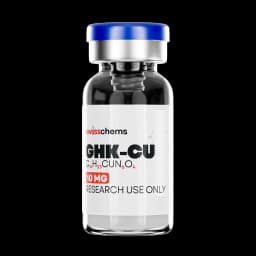
Ready to source GHK-Cu?
Use code PEPTIDEWIKI for 10% off every order at SwissChems.
Affiliate link — commission at no extra cost to you.