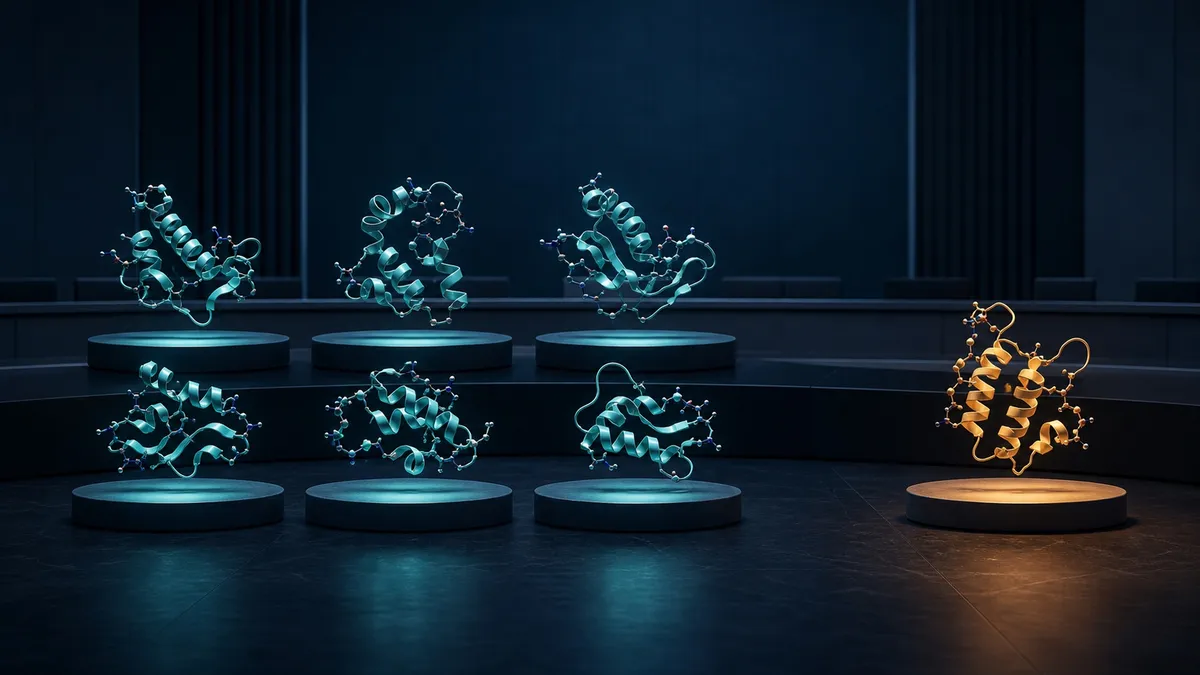
Among the dozens of peptides discussed in the longevity and anti-aging space, GHK-Cu occupies a unique position. It's not a synthetic creation designed in a lab — it's a naturally occurring tripeptide that your body already produces. And unlike many research peptides that rely primarily on animal study data, GHK-Cu has a research history spanning over 50 years, with data from cell culture, animal models, and human applications in wound healing and skincare.
The catch? Your body's GHK-Cu levels decline significantly with age — dropping from approximately 200 ng/mL in plasma at age 20 to 80 ng/mL by age 60 (Pickart et al., 2012). That decline parallels the deterioration of wound healing, skin quality, hair health, and regenerative capacity that characterizes aging.
Understanding GHK-Cu means understanding one of the most interesting molecules in peptide science — one that sits at the intersection of skin health, wound healing, gene expression, and aging biology.
What Is GHK-Cu?
GHK-Cu (glycyl-L-histidyl-L-lysine copper) is a tripeptide — just three amino acids (glycine, histidine, lysine) bound to a copper ion. It was first identified in human plasma by Loren Pickart in 1973, when he observed that plasma from young individuals could stimulate old liver tissue to synthesize proteins at rates characteristic of younger tissue. The active factor was isolated and identified as GHK-Cu.
Despite its small size, GHK-Cu has a remarkably broad range of biological activities. It's present in plasma, saliva, and urine, and its concentration decreases substantially with age.
The copper ion isn't incidental — it's essential to GHK-Cu's function. Copper is a cofactor for multiple enzymes involved in collagen synthesis, antioxidant defense, and tissue remodeling. The GHK peptide serves as a delivery vehicle that brings copper to tissues where it's needed, while also having direct signaling effects of its own.
Mechanism of Action
GHK-Cu works through multiple pathways — which is part of what makes it unusual and interesting compared to more single-target peptides.
Collagen and ECM Production
GHK-Cu stimulates collagen synthesis by activating fibroblasts — the cells responsible for producing collagen, elastin, and other extracellular matrix (ECM) components. Studies have shown it specifically upregulates:
- Type I collagen (the primary structural collagen in skin and connective tissue)
- Decorin (a proteoglycan that regulates collagen fibril assembly)
- Glycosaminoglycans (including hyaluronic acid, critical for skin hydration)
At the same time, GHK-Cu inhibits metalloproteinases (MMPs) — the enzymes that break down collagen. This dual action (building more collagen while slowing its degradation) is one reason GHK-Cu's effects on skin are more pronounced than you might expect from a simple tripeptide.
Wound Healing
GHK-Cu promotes wound healing through several coordinated mechanisms:
- Angiogenesis — stimulating new blood vessel formation at wound sites
- Nerve growth — promoting nerve outgrowth and sensory recovery
- Fibroblast recruitment — attracting repair cells to the wound
- Anti-inflammatory effects — reducing oxidative damage and inflammatory signaling at wound sites
- Stem cell recruitment — attracting mesenchymal stem cells involved in tissue repair
Clinical studies in burn patients and post-surgical wound care have demonstrated accelerated healing with GHK-Cu treatment (Leyden et al., 1987; Mulder et al., 1994).
Gene Expression: The Most Interesting Finding
In 2012, Loren Pickart's group published what may be the most intriguing GHK-Cu finding to date. Using the Broad Institute's Connectivity Map, they analyzed GHK-Cu's effects on genome-wide gene expression and found that it modulates the activity of 4,000+ human genes — approximately 6% of the human genome (Pickart et al., 2012; Campbell et al., 2012).
The pattern of modulation was striking:
- Genes involved in tissue repair and regeneration were upregulated
- Genes involved in inflammation and tissue destruction were suppressed
- The overall gene expression profile shifted toward patterns associated with younger tissue
Specifically, GHK-Cu was found to:
- Activate 31 genes related to collagen and ECM formation
- Suppress 36 genes involved in metalloproteinase activity (collagen breakdown)
- Activate DNA repair genes (including GADD45A, critical for DNA damage response)
- Suppress genes associated with fibrinogen production (a marker of chronic inflammation)
- Modulate TGF-beta signaling — a key pathway in both wound healing and fibrosis
The researchers concluded that GHK-Cu's gene expression effects were "consistent with improving tissue repair, reducing inflammation, increasing collagen synthesis, and restoring to a more healthy state."
This gene expression data doesn't prove that GHK-Cu "reverses aging" — that's a much larger claim than the data supports. But it does suggest that age-related decline in GHK-Cu may contribute to changes in gene expression that characterize aging tissue, and that restoring GHK-Cu levels may partially reverse those expression patterns.
GHK-Cu for Skin
Skin applications are GHK-Cu's most well-studied and commercially available use.
Clinical Evidence
Leyden et al. (1987) conducted one of the earliest clinical studies, applying GHK-Cu cream to facial skin over 12 weeks. Results showed significant improvements in skin firmness and reduced appearance of fine lines.
Finkley et al. (2005) studied GHK-Cu facial cream in a controlled trial and found it:
- Improved skin density and thickness (measured by ultrasound)
- Reduced fine lines and wrinkles
- Improved skin clarity
- Results were comparable to or better than vitamin C and retinoic acid creams used as comparators
Abdulghani et al. (1998) found that GHK-Cu cream improved skin laxity and tightening, with visible results in as little as 4 weeks.
How It Compares to Retinol
GHK-Cu and retinol (vitamin A) are the two most evidence-supported anti-aging topical ingredients, but they work through different mechanisms:
- Retinol increases cell turnover, stimulates collagen production through retinoic acid receptors, and thins the stratum corneum. It's well-studied but causes irritation, dryness, photosensitivity, and peeling — especially at therapeutic concentrations.
- GHK-Cu stimulates collagen through fibroblast activation and ECM remodeling, while simultaneously inhibiting degradation. It's generally well-tolerated with minimal irritation.
Many dermatologists consider them complementary rather than competing — they can be used at different times (retinol at night, GHK-Cu morning, or alternating days) for additive effects.
GHK-Cu for Hair Growth
Hair loss is one of the most actively researched GHK-Cu applications, though the evidence is earlier-stage than skin data.
The Biological Case
Hair follicles depend on several processes that GHK-Cu influences:
- Blood supply — GHK-Cu promotes angiogenesis, which supports nutrient delivery to hair follicles
- Follicle cell proliferation — GHK-Cu stimulates dermal papilla cells (the cells at the base of the follicle that regulate hair growth)
- Stem cell activity — GHK-Cu recruits mesenchymal stem cells, which play a role in the hair follicle regeneration cycle
- Anti-inflammatory effects — inflammation around follicles (a component of androgenetic alopecia) contributes to miniaturization and hair loss
- ECM support — the extracellular matrix surrounding follicles affects their growth cycle
Research Data
Pyo et al. (2007) studied GHK in human dermal papilla cells (the critical cell type for hair growth) and found it increased expression of multiple genes involved in hair follicle development and growth.
Uno and Kurata (1993) demonstrated in an animal model that copper peptide compounds increased hair follicle size and stimulated the transition from resting (telogen) phase to active growth (anagen) phase.
Topical GHK-Cu serums and scalp treatments are increasingly available, though large-scale, placebo-controlled human trials specifically for hair loss are still needed. The biological plausibility is strong, the preliminary data is encouraging, and the safety profile for topical use is well-established — but we're not yet at the evidence level of proven hair loss treatments like minoxidil or finasteride.
GHK-Cu for Anti-Aging and Longevity
The anti-aging case for GHK-Cu rests on three pillars:
1. Natural Decline with Age
GHK-Cu levels drop approximately 60% between age 20 and 60. This decline correlates with reduced wound healing capacity, skin quality deterioration, and changes in gene expression associated with aging.
2. Gene Expression Remodeling
The Broad Institute data showing GHK-Cu modulates 4,000+ genes toward younger expression profiles is the most compelling anti-aging finding. If validated in long-term human studies, this suggests GHK-Cu supplementation could partially counteract age-related gene expression changes.
3. Multi-System Effects
Unlike single-target anti-aging interventions, GHK-Cu affects multiple systems simultaneously — collagen production, inflammation, DNA repair, antioxidant defense, stem cell recruitment, and tissue remodeling. This broad-spectrum activity is consistent with addressing aging as a systemic process rather than a single-pathway problem.
Limitations
The anti-aging narrative is compelling but must be held in perspective:
- Gene expression changes don't necessarily translate to functional rejuvenation
- The gene expression data comes from cell culture models, not long-term human aging studies
- No human longevity trials have been conducted with GHK-Cu
- The leap from "restores younger gene expression patterns" to "extends lifespan or healthspan" is substantial and unproven
GHK-Cu is one of the more scientifically grounded entries in the anti-aging peptide space, but the strongest current evidence is for skin quality and wound healing — not lifespan extension.
How to Use GHK-Cu
Topical (Most Common for Skin and Hair)
Topical application is the most accessible and best-studied form for skin and hair applications.
- Concentration: Most clinical studies used formulations containing 1-3% GHK-Cu (sometimes listed as "copper peptides" on skincare labels)
- Application: Applied once or twice daily to clean skin
- Results timeline: 4-12 weeks for visible changes in skin quality; hair effects may take longer (3-6 months)
- Compatibility: Works well with hyaluronic acid, vitamin C serums, and other actives. Use caution combining with strong acids (AHA/BHA at high concentrations) which may affect the copper complex
Subcutaneous Injection
Injectable GHK-Cu is used by some for more systemic anti-aging and regenerative effects.
- Dose: 1-2 mg daily or several times per week
- Duration: 4-8 week cycles
- Reconstitution: Standard bacteriostatic water process
Use our Peptide Dosage Calculator for reconstitution math.
Microneedling with GHK-Cu
Combining GHK-Cu with microneedling (dermarolling or professional microneedling) is an increasingly popular approach. Microneedling creates micro-channels that dramatically increase topical peptide absorption while also triggering a wound healing response that GHK-Cu can amplify.
This combination should ideally be done under professional guidance, as the depth and technique of microneedling affect both results and risk.
Safety Profile
GHK-Cu has one of the best safety profiles among bioactive peptides.
Topical Use
- Very well tolerated — most studies report no significant adverse reactions
- No photosensitivity (unlike retinol)
- Minimal irritation — suitable for sensitive skin types
- Rare reports of mild redness or tingling that resolves quickly
Injectable Use
- Injection site irritation — mild, typical of any subcutaneous injection
- Theoretical concerns — as with any peptide that promotes angiogenesis and cell proliferation, avoid with active cancer
- Copper sensitivity — rare, but individuals with Wilson's disease (copper metabolism disorder) should avoid GHK-Cu
Contraindications
- Active cancer — the cell proliferation and angiogenic effects are a theoretical concern
- Wilson's disease — impaired copper metabolism
- Pregnancy and breastfeeding — insufficient safety data
- Copper allergy — rare but possible
GHK-Cu vs Other Anti-Aging Peptides
| Peptide | Mechanism | Best For | Evidence Level |
|---|---|---|---|
| GHK-Cu | Collagen + ECM + gene expression | Skin, wound healing, broad anti-aging | Strong (50+ years of research, human data for skin/wound healing) |
| Epitalon | Telomerase activation (proposed) | Longevity (theoretical) | Preliminary (cell culture, some animal data) |
| MOTS-c | AMPK activation, metabolic regulation | Exercise capacity, metabolic aging | Moderate (animal data, early human studies) |
| BPC-157 | Growth factor modulation, tissue repair | Injury recovery, gut health | Moderate (extensive preclinical, no human trials) |
| SS-31 | Mitochondrial targeting | Mitochondrial aging | Moderate (human trials for specific conditions) |
GHK-Cu's advantage is the combination of breadth of action, longevity of research history, and established safety in topical human use. Its limitation is the gap between the compelling gene expression data and the lack of long-term human aging studies.
Key Takeaways
- GHK-Cu is a naturally occurring copper peptide that declines ~60% with age
- It stimulates collagen production, inhibits collagen breakdown, promotes wound healing, and modulates 4,000+ genes
- Strongest evidence is for skin quality improvement — firmness, wrinkle reduction, thickness, and clarity
- Hair growth data is preliminary but biologically compelling
- Anti-aging gene expression data is the most intriguing finding but needs long-term human validation
- Topical formulations (1-3%) are the most accessible and best-studied delivery method
- Safety profile is excellent — especially for topical use
- Available in topical, injectable, and microneedling-compatible formats
- Browse our Peptide Directory for more peptide profiles
This article is for educational and informational purposes only. It is not medical advice. Always consult with a qualified healthcare provider or dermatologist before starting any new skincare or peptide regimen.
Key References:
- Pickart L, Vasquez-Soltero JM, Margolina A. "GHK peptide as a natural modulator of multiple cellular pathways in skin regeneration." BioMed Res Int. 2015;2015:648108.
- Pickart L, Vasquez-Soltero JM, Margolina A. "GHK-Cu may prevent oxidative stress in skin by regulating copper and modifying expression of numerous antioxidant genes." Cosmetics. 2015;2(3):236-247.
- Campbell JD, et al. "Wound healing and aging: a new therapeutic target." J Invest Dermatol. 2012;132:929-932.
- Finkley MB, et al. "Facial cream containing copper peptides reduces signs of photoaging." J Cosmet Dermatol. 2005;4(4):245-249.
- Pyo HK, et al. "The effect of tripeptide-copper complex on human hair growth in vitro." Arch Pharm Res. 2007;30(7):834-839.
- Mulder GD, et al. "Enhanced healing of ulcers in patients with diabetes by topical treatment with glycyl-L-histidyl-L-lysine copper." Wound Repair Regen. 1994;2(4):259-269.
- Leyden JJ, et al. "Copper-peptide complex improves skin appearance." J Am Acad Dermatol. 1987;17:252-258.
- Pickart L. "The human tri-peptide GHK and tissue remodeling." J Biomater Sci Polym Ed. 2008;19(8):969-988.